How to Tell If Gold Is Real: 12 Methods From Simple to Scientific
Learn 12 proven methods to test if gold is real, from simple at-home checks like the magnet test to professional techniques like XRF spectrometry and fire assay.
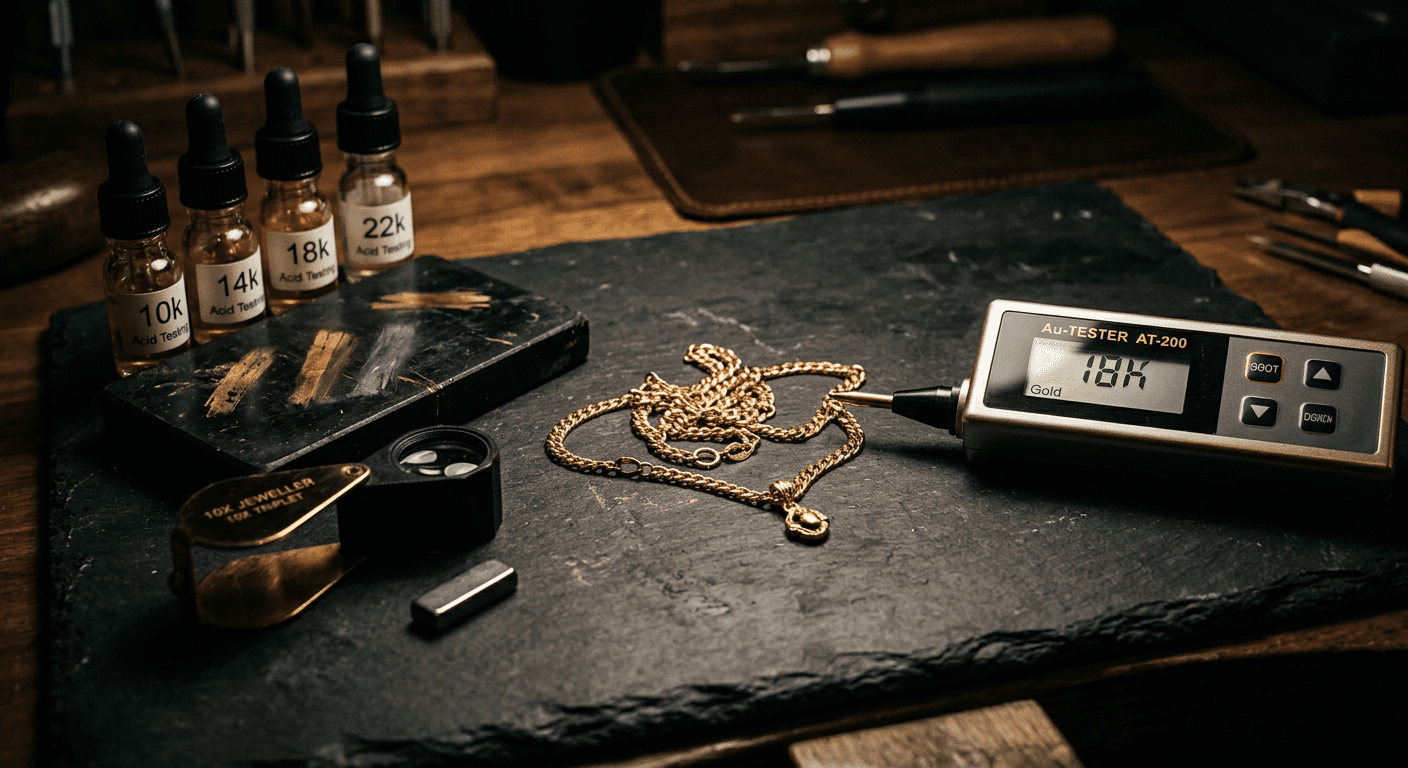
Whether you just inherited a ring from your grandmother, picked up a gold chain at a pawn shop, or simply want to verify a piece before spending thousands of dollars, knowing how to tell if gold is real is a skill that can save you from costly mistakes. Counterfeit gold has existed for as long as gold itself, and modern fakes are more sophisticated than ever.
In this guide, we walk through 12 methods to test gold authenticity - arranged from the simplest visual checks you can do in seconds to the most advanced laboratory techniques used by professional assayers. Each method has its own strengths and limitations, and no single test is foolproof on its own. The best approach is to combine multiple methods before drawing a conclusion.
Quick Self-Assessment
Not sure where to start? Try our interactive Is My Gold Real? quiz for a guided walkthrough of the most common authenticity checks.
Understanding Gold Fakes Before You Test
Before diving into the methods, it helps to understand what you might be dealing with. Not all "fake" gold is the same, and different types of counterfeits will fool different tests.
Gold-Plated Jewelry
Gold-plated items have a thin layer of real gold (typically 0.5 to 2.5 microns thick) bonded to a base metal like brass, copper, or stainless steel. The surface layer is genuine gold, which means surface-level tests like the acid test or ceramic test may initially pass. However, the gold layer is so thin that it wears away quickly, and tests that measure density or weight will reveal the deception.
Gold-Filled Jewelry
Gold-filled pieces have a much thicker layer of gold mechanically bonded to a base metal core. By FTC standards, gold-filled items must contain at least 5% gold by total weight. These are harder to detect than gold-plated items because the gold layer is substantial enough to pass many surface tests. Look for stamps like "GF," "1/20 14K GF," or "1/10 10K GF."
Solid Gold (But Lower Karat)
Sometimes the gold is real but the karat is misrepresented. A ring stamped 14K might actually be 10K, or a piece marked 750 (18K) could actually be 585 (14K). This type of fraud requires quantitative testing methods like acid testing, electronic testers, or XRF to detect.
Tungsten-Core Counterfeits
Tungsten is the gold counterfeiter's dream material. Its density (19.25 g/cm3) is nearly identical to gold's (19.32 g/cm3), making it almost impossible to detect through weight or water displacement tests alone. Tungsten-core gold bars and coins are a known threat in the bullion market and require advanced methods like ultrasonic testing or XRF to identify.
Method 1: Look for Hallmarks and Stamps
Difficulty: Easy | Reliability: Low-Moderate | Destructive: No | Cost: Free
The first and simplest check is to look for official hallmarks, purity stamps, or maker's marks on the piece. Legitimate gold jewelry almost always carries some form of stamping that indicates its purity.
What to Look For
- Karat stamps: 10K, 14K, 18K, 22K, 24K (or the metric equivalents: 417, 585, 750, 916, 999)
- Maker's marks: Registered trademarks of the manufacturer
- Assay office marks: Common on European jewelry, indicating the piece was tested by an official assay office
- Country of origin marks: Some countries require these
Use a jeweler's loupe (10x magnification) to inspect stamps closely. Look at the edges of the stamping - genuine stamps are clean and evenly pressed, while fakes often look shallow, uneven, or slightly blurred.
Limitations
Stamps can be faked. A counterfeit piece can be stamped "14K" just as easily as a real one. Additionally, very old gold jewelry (pre-1900s) may not carry any stamps at all, especially if it was handcrafted. Stamps are a good starting point but never definitive proof.
You can use our stamp decoder tool to look up what specific hallmarks and purity codes mean. For a full breakdown of karat values and what they represent, see our gold karat chart.
FTC Gold Labeling Rules
Under U.S. Federal Trade Commission guidelines (16 CFR Part 23), any item described as "gold" without a karat qualifier must be at least 10 karats. Items below 10K cannot legally be called gold jewelry in the United States. If a piece is stamped with a karat mark, the actual purity must be within 0.5 karats of what is stated (with a tolerance for solder content). Misrepresenting gold purity is a violation of federal trade regulations.
Method 2: The Magnet Test
Difficulty: Easy | Reliability: Low | Destructive: No | Cost: Free (if you have a magnet)
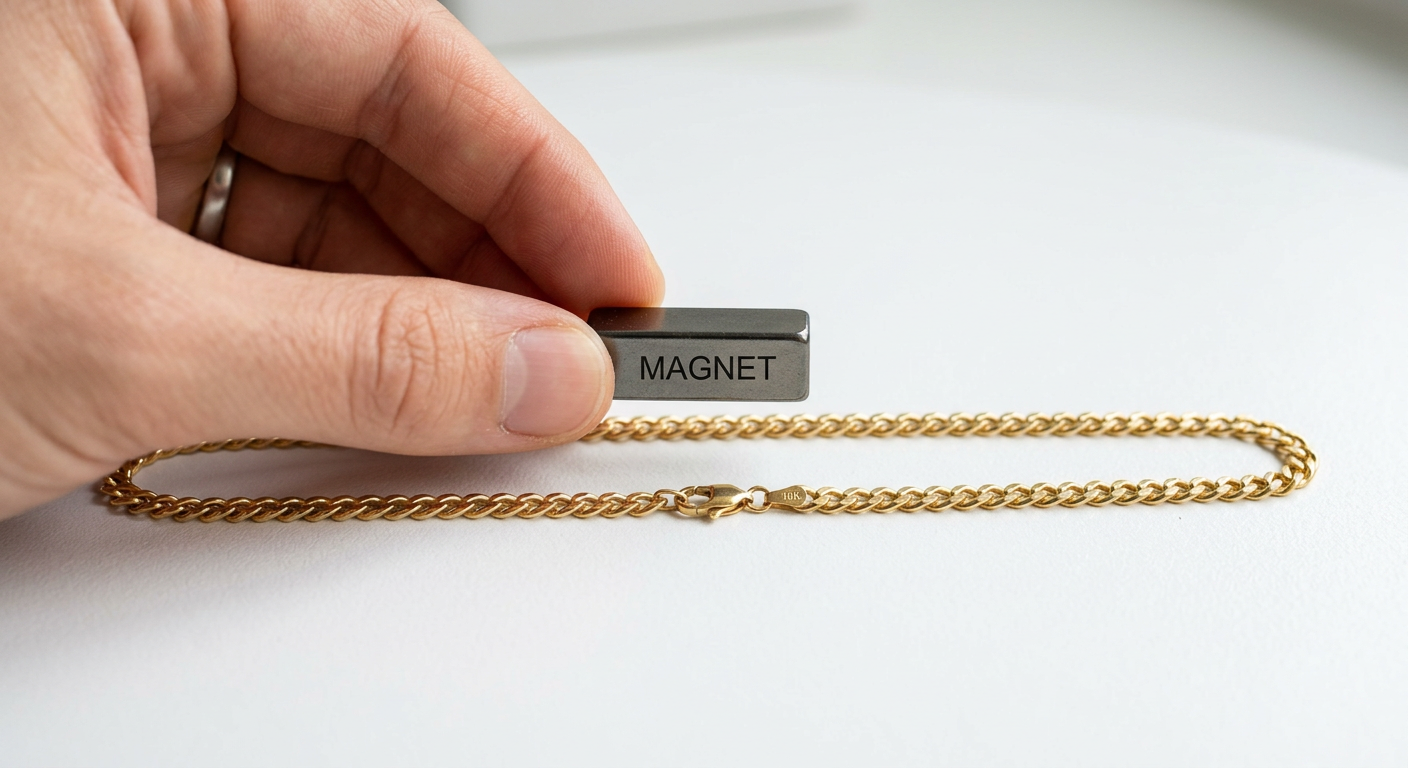
Gold is not magnetic. If a piece of jewelry is strongly attracted to a magnet, it is not gold - or at best, it contains a significant amount of magnetic base metal beneath a gold layer.
How to Perform It
- Get a strong neodymium magnet (rare earth magnet). Refrigerator magnets are usually too weak.
- Hold the magnet near the item.
- Observe whether the item is attracted to the magnet.
What to Look For
- Strong attraction: Definitely not solid gold. The piece likely contains iron, nickel, or cobalt.
- No attraction: The piece could be gold, but it could also be a non-magnetic metal like copper, brass, aluminum, lead, or tungsten. Passing the magnet test does not confirm the item is gold.
- Slight pull: Some gold alloys (particularly white gold alloyed with nickel) may show a very faint magnetic response. This alone does not mean the piece is fake.
Limitations
The magnet test can only rule items in as fake - it cannot confirm authenticity. Many common counterfeiting materials (brass, copper, tungsten) are non-magnetic and will pass this test just as easily as real gold. Think of the magnet test as a quick "first filter" rather than a definitive answer.
Method 3: The Skin Discoloration Test
Difficulty: Easy | Reliability: Low | Destructive: No | Cost: Free
Real gold does not react with skin or cause discoloration. If a gold-colored piece of jewelry leaves green or black marks on your skin, it is likely made from or contains a significant amount of copper, nickel, or other reactive base metals.
How to Perform It
- Clean the piece of jewelry and your skin thoroughly.
- Wear the piece against bare skin for several hours (or overnight).
- Check for any green, black, or dark discoloration where the metal contacted your skin.
What to Look For
- Green marks: Usually indicate the presence of copper. Common with brass or low-karat gold alloys.
- Black marks: Can indicate silver content reacting with sulfur compounds on the skin.
- No marks: Consistent with higher-karat gold, but does not confirm authenticity.
Limitations
This test is unreliable for several reasons. Some people's skin chemistry causes reactions even with real gold alloys. Cosmetics, lotions, and sweat composition all affect the results. Additionally, well-plated fake gold will not cause discoloration until the plating wears through. Low-karat genuine gold (10K or 14K) can sometimes cause mild skin reactions because of its alloy metals, which does not mean it is fake.
Method 4: The Ceramic Streak Test
Difficulty: Easy | Reliability: Moderate | Destructive: Mildly (scratches the piece) | Cost: Free
When gold is dragged across unglazed ceramic (such as the back of a porcelain tile), it leaves a characteristic gold-colored streak. Fake gold and most base metals leave a dark or black streak instead.
How to Perform It
- Obtain an unglazed ceramic plate or tile. The unfinished back of a bathroom tile works well.
- Press the gold item firmly against the ceramic surface.
- Drag it across the surface with moderate pressure.
- Examine the color of the streak left behind.
What to Look For
- Gold/yellow streak: Consistent with real gold.
- Black or dark streak: Indicates pyrite (fool's gold), brass, or another base metal.
- No streak: The item may be too hard, which is unusual for gold (gold is relatively soft).
Limitations
This test will leave a small scratch on the item, so it is not suitable for valuable or sentimental pieces. Gold-plated items may leave a gold streak from their surface layer, giving a false positive. The test also does not tell you the karat of the gold - 14K and 24K both leave gold streaks.
Method 5: The Weight and Density Test (Specific Gravity)
Difficulty: Moderate | Reliability: High | Destructive: No | Cost: Low (requires a precision scale)
Gold is exceptionally dense at 19.32 g/cm3 for pure 24K gold. This density is much higher than most common metals used in counterfeiting (brass is about 8.5 g/cm3, copper is 8.96 g/cm3). The specific gravity test is one of the most reliable non-destructive methods for testing gold.
How to Perform It
- Weigh the item in air on a precision scale (accurate to 0.01g). Record this as the "dry weight."
- Suspend the item in distilled water using a thin thread or wire (the thread's weight should be negligible).
- Record the "wet weight" while the item is fully submerged.
- Calculate specific gravity: Dry Weight / (Dry Weight - Wet Weight).
Expected Specific Gravity Values
| Karat | Gold Purity | Expected Specific Gravity |
|---|---|---|
| 24K | 99.9% | 19.32 |
| 22K | 91.7% | 17.7 - 17.8 |
| 18K | 75.0% | 15.2 - 15.9 |
| 14K | 58.5% | 12.9 - 14.0 |
| 10K | 41.7% | 11.3 - 11.8 |
Limitations
This test requires a precision scale and careful technique. Hollow pieces, items with gemstones, or pieces with internal cavities will give inaccurate readings. And as noted earlier, tungsten has a density of 19.25 g/cm3 - so close to gold that this test cannot distinguish between them. For solid bars and coins, the specific gravity test is highly effective. For jewelry with mixed materials, it is less reliable.
Method 6: The Water Displacement Test
Difficulty: Moderate | Reliability: Moderate-High | Destructive: No | Cost: Free
This is a simplified version of the specific gravity test using Archimedes' principle. If you know the weight of the item, you can determine its volume through water displacement and then calculate its density.
How to Perform It
- Weigh the gold item precisely.
- Fill a graduated cylinder or measuring container with water and note the starting level.
- Carefully lower the item into the water.
- Note the new water level. The difference is the item's volume in milliliters (or cubic centimeters).
- Calculate density: Weight (grams) / Volume (cm3).
What to Look For
Compare your calculated density to the known densities of gold at various purities (see the specific gravity table above). If the density is significantly off from what the stamp claims, the item may be fake or misrepresented.
Limitations
This method requires careful measurement and works best with larger items where volume displacement is easier to measure accurately. Small items like rings produce very small volume changes that are hard to read precisely on a standard graduated cylinder. Air bubbles trapped on the item's surface can also distort the reading.
Method 7: The Float Test
Difficulty: Easy | Reliability: Very Low | Destructive: No | Cost: Free
Gold is extremely dense and will sink immediately in water. If an item floats or sinks slowly, it is almost certainly not solid gold.
How to Perform It
- Fill a glass or bowl with water.
- Drop the item into the water.
- Watch how it behaves.
What to Look For
- Sinks immediately: Consistent with gold (but also consistent with many other dense metals).
- Floats or hovers: Definitely not solid gold.
- Sinks slowly: Likely not gold, but could be a hollow gold piece.
Limitations
This is the least reliable test on our list. Nearly every metal used to fake gold (brass, copper, lead, stainless steel, tungsten) also sinks in water. A piece sinking does not tell you anything useful about whether it is gold. The float test can only identify extremely obvious fakes made from lightweight materials - something that almost never happens with modern counterfeits. Consider this a "fun fact" test rather than a serious authentication method.
Method 8: The Vinegar Test
Difficulty: Easy | Reliability: Low-Moderate | Destructive: No (for real gold) | Cost: Free
Gold does not react with acetic acid (vinegar). Applying vinegar to a piece and watching for a reaction can help identify some fakes, particularly those made from base metals that oxidize readily.
How to Perform It
- Clean the item thoroughly.
- Apply a few drops of white vinegar (5% acetic acid) to the surface.
- Wait 5 to 10 minutes.
- Observe any changes in color or surface appearance.
What to Look For
- No change: Consistent with real gold. The metal should remain the same color.
- Darkening, bubbling, or color change: Indicates a base metal or heavily alloyed piece. Copper turns green, and some alloys will darken.
Limitations
Vinegar is a weak acid, so it will not react with many non-gold metals either. Stainless steel, platinum, and even some brass alloys will show no reaction. Gold-plated items will typically pass this test since the surface layer is real gold. The vinegar test is too mild to detect sophisticated fakes. It is useful mainly for identifying the most obvious counterfeits.
Method 9: The Nitric Acid Test
Difficulty: Moderate-Hard | Reliability: High | Destructive: Yes (requires a scratch) | Cost: $15 - $30 for acid kit
The nitric acid test is the classic method used by jewelers and pawn shops. It relies on the fact that gold does not dissolve in nitric acid alone (gold requires aqua regia, a mixture of nitric and hydrochloric acid, to dissolve).
How to Perform It
- Make a small scratch on an inconspicuous area of the item to get below any plating.
- Apply a drop of nitric acid to the scratch.
- Observe the reaction.
Testing kits typically include acids of different strengths, each calibrated to test a specific karat:
- 10K acid: Dissolves anything below 10K
- 14K acid: Dissolves anything below 14K
- 18K acid: Dissolves anything below 18K
- 22K acid: Dissolves anything below 22K
What to Look For
- No reaction (acid sits without bubbling or changing color): Gold at or above the acid's karat threshold.
- Green fizzing: Base metal, not gold.
- Milky white reaction: Sterling silver.
- Gold dissolves: Gold is below the karat level of the acid used.
Limitations
Acid testing is destructive - you must scratch the piece. The acids are hazardous and require careful handling with gloves and proper ventilation. Results can be ambiguous with heavily alloyed pieces. Gold-filled items may pass if the scratch is not deep enough to reach the base metal core. Despite these drawbacks, acid testing remains one of the most practical and reliable field methods for gold authentication.
Safety Warning
Nitric acid is a strong corrosive substance. Always wear chemical-resistant gloves, safety goggles, and work in a well-ventilated area. Never mix nitric acid with other chemicals unless you know exactly what you are doing. Store acid testing kits out of reach of children.
Method 10: Electronic Gold Testers
Difficulty: Easy-Moderate | Reliability: Moderate-High | Destructive: No | Cost: $100 - $1,000+
Electronic gold testers use electrical conductivity or electromagnetic properties to estimate gold purity. These devices are widely used by jewelers, pawn shops, and gold dealers because they provide quick, non-destructive results with reasonable accuracy.
How They Work
Most electronic testers work by measuring the electrical resistance of the metal's surface. Different metals and alloys have different conductivity profiles, and the device compares the reading against known values for gold at various karats. Some advanced models use multiple test modes and can identify the specific alloy composition.
Popular brands include the Kee Gold Tester, GoldScreenSensor, and Sigma Metalytics Precious Metal Verifier.
How to Use One
- Calibrate the tester according to the manufacturer's instructions.
- Clean the test surface of the gold item.
- Apply the probe or sensor to the metal surface.
- Read the karat result on the display.
Limitations
Electronic testers read only the surface layer of the metal. This means gold-plated or gold-filled items can fool basic models. Temperature, surface condition, and contact pressure all affect accuracy. Cheaper testers (under $200) tend to have wider accuracy margins and can misidentify alloys. The Sigma Metalytics verifier is more reliable because it uses electromagnetic waves that penetrate deeper into the metal, but it costs significantly more.
Method 11: XRF Spectrometry
Difficulty: Requires professional equipment | Reliability: Very High | Destructive: No | Cost: $200 - $500 per test (or $20,000+ to buy a unit)
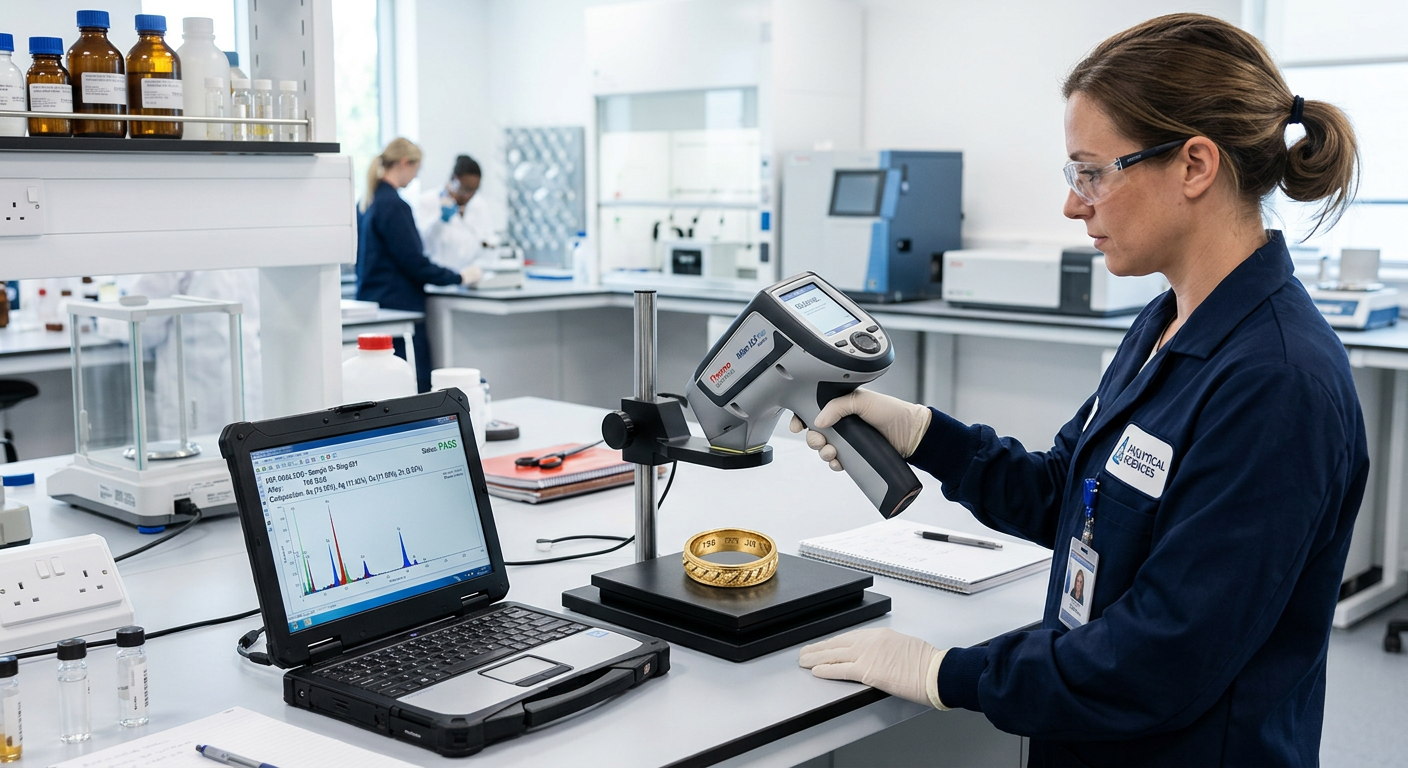
X-Ray Fluorescence (XRF) spectrometry is the gold standard (no pun intended) for non-destructive precious metal analysis. It works by bombarding the item with X-rays and measuring the characteristic fluorescent radiation that bounces back, which reveals the exact elemental composition of the material.
How It Works
- The item is placed in the XRF analyzer's test chamber or under its probe.
- The device fires X-rays at the sample.
- Each element in the sample emits fluorescent X-rays at unique energy levels.
- The detector identifies and quantifies every element present.
- Results are displayed as a percentage breakdown (e.g., 75.1% Au, 15.2% Cu, 9.7% Ag).
Strengths
- Non-destructive - no scratching, cutting, or chemical exposure
- Identifies all elements in the alloy, not just gold
- Accuracy within 0.1% for gold content
- Results in seconds
- Can detect gold plating thickness on some advanced models
Limitations
XRF measures the surface composition, typically penetrating about 10 to 50 microns depending on the element and the instrument. This means that thick gold plating could still yield misleading results, though the ratio of elements detected can help an experienced operator identify plating. Tungsten-core items with gold shells thicker than the X-ray penetration depth can also fool XRF analysis. The equipment is expensive, so this test is typically done at a jeweler, assay office, or precious metals dealer.
Method 12: Fire Assay (Cupellation)
Difficulty: Expert only | Reliability: Highest possible | Destructive: Yes (destroys the sample) | Cost: $50 - $200 per test
Fire assay by cupellation is the oldest and most accurate method of determining gold purity. It has been used for over 5,000 years and remains the benchmark against which all other gold testing methods are calibrated. When international standards bodies or refineries need to certify gold purity with absolute certainty, they use fire assay.
How It Works
- A small sample is cut from the item (typically 250-500 mg).
- The sample is wrapped in lead foil and placed in a cupel (a porous cup made of bone ash or magnite).
- The cupel is placed in a muffle furnace at approximately 1,100 degrees Celsius.
- At this temperature, the lead oxidizes and absorbs base metals. The lead oxide is absorbed into the porous cupel.
- What remains is a bead of precious metals (gold and silver).
- The silver is removed using nitric acid (parting).
- The remaining gold bead is weighed, and its weight relative to the original sample gives the exact gold content.
This process is defined by ISO 11426 and is the reference standard for gold fineness determination worldwide.
Limitations
Fire assay destroys the sample, so it is not suitable for testing finished jewelry you want to keep intact. It requires specialized laboratory equipment and trained personnel. It is also relatively expensive and time-consuming compared to non-destructive methods. Fire assay is primarily used for refinery samples, bullion certification, and legal disputes where absolute accuracy is required.
Comparison of All 12 Methods
| Method | Difficulty | Reliability | Destructive? | Cost |
|---|---|---|---|---|
| Hallmark inspection | Easy | Low-Moderate | No | Free |
| Magnet test | Easy | Low | No | Free |
| Skin discoloration | Easy | Low | No | Free |
| Ceramic streak test | Easy | Moderate | Mildly | Free |
| Specific gravity | Moderate | High | No | Low ($20-50 for scale) |
| Water displacement | Moderate | Moderate-High | No | Free |
| Float test | Easy | Very Low | No | Free |
| Vinegar test | Easy | Low-Moderate | No | Free |
| Nitric acid test | Moderate-Hard | High | Yes | $15-30 |
| Electronic tester | Easy-Moderate | Moderate-High | No | $100-1,000+ |
| XRF spectrometry | Professional | Very High | No | $200-500 per test |
| Fire assay | Expert | Highest | Yes | $50-200 per test |
Common Gold Fakes and How They Fool Tests
Understanding the most common types of counterfeit gold helps you choose the right combination of tests.
Brass Masquerading as Gold
Brass (a copper-zinc alloy) has a similar color to low-karat gold and is the most common material used for cheap fakes. It is easy to detect with acid tests, density tests, and even the ceramic streak test (brass leaves a darker streak). However, gold-plated brass can pass many surface-level tests.
Tungsten-Filled Bars and Coins
Tungsten's near-identical density to gold makes it the most dangerous counterfeiting material for bullion. Sophisticated fakes involve a tungsten core with a genuine gold shell that is thick enough to pass XRF surface analysis. These can be detected with ultrasonic testing (sound travels at different speeds through gold and tungsten) or by drilling/cutting the piece.
Gold-Plated Sterling Silver
Sterling silver with a heavy gold plating can pass the magnet test, float test, and may partially pass acid tests if the plating is thick enough. The specific gravity test is effective here since silver's density (10.49 g/cm3) is significantly lower than gold's.
Cadmium-Gold Alloys
Some unscrupulous manufacturers use cadmium (a toxic heavy metal) to bulk up gold alloys while maintaining some gold content. These pieces may technically contain gold but at a lower karat than claimed. Electronic testers and XRF analysis can identify cadmium content.
When to Seek Professional Testing
While home testing methods are useful for initial screening, there are situations where professional testing is the right choice:
- High-value purchases: Before spending $1,000 or more on gold jewelry or bullion, a professional XRF or fire assay test is a worthwhile investment.
- Estate and inheritance pieces: When the provenance is unknown and the item has significant sentimental or monetary value.
- Investment bullion: Gold bars and coins purchased from non-authorized dealers should always be professionally verified.
- Insurance documentation: Insurance companies may require a professional appraisal with documented testing.
- Legal disputes: Only fire assay results are typically accepted as definitive evidence in legal proceedings involving gold purity claims.
Most reputable jewelers offer basic gold testing (acid test or electronic tester) for free or a small fee. Assay offices and precious metals dealers provide XRF testing, typically for $25 to $50 per item. Fire assay is available through specialized laboratories and refineries.
Combining Methods for Confidence
No single test is perfect. For the highest confidence in your results, use at least three methods from different categories. Start with a visual inspection (Method 1), follow with a density-based test (Method 5 or 6), and confirm with a chemical or electronic test (Method 9 or 10). This layered approach dramatically reduces the chance of being fooled by a sophisticated fake.
Understanding Gold Purity Grades
When you test gold and get a result, you need to know what it means. Gold purity is expressed in karats (K or kt), millesimal fineness, or percentage. Here is a quick reference:
- 24K / 999 / 99.9% - Pure gold. Too soft for most jewelry.
- 22K / 916 / 91.7% - Common in Indian and Middle Eastern jewelry.
- 18K / 750 / 75.0% - Popular for fine jewelry worldwide. See our 750 gold guide.
- 14K / 585 / 58.5% - The most popular purity in the U.S. and Europe. Learn more in our 585 gold guide.
- 10K / 417 / 41.7% - The minimum karat to be legally called "gold" in the U.S.
For a comprehensive breakdown including alloy compositions and color variations, see our complete gold karat chart. If you are deciding between the two most popular karats, check out our 14K vs 18K gold comparison.
Protecting Yourself When Buying Gold
Beyond testing, here are practical steps to reduce your risk of purchasing counterfeit gold:
- Buy from reputable dealers. Authorized retailers, established jewelers, and recognized online dealers with strong return policies are far less likely to sell fakes.
- Request documentation. Legitimate gold items should come with a certificate of authenticity, receipt, or assay certificate for bullion.
- Be skeptical of deals that seem too good to be true. If someone is selling gold significantly below the spot price, ask yourself why.
- Check the weight. If you know the item's karat and dimensions, you can estimate what it should weigh. A significant discrepancy is a red flag.
- Inspect craftsmanship. Quality gold jewelry has clean finishing, secure settings, and well-applied stamps. Sloppy construction often accompanies fake materials.
- Use a trusted testing method. Even when buying from a reputable source, verify the piece if it represents a significant investment.
Frequently Asked Questions
Final Thoughts
Learning how to tell if gold is real does not require expensive equipment or a chemistry degree. Starting with free, simple tests like hallmark inspection and the magnet test can eliminate the most obvious fakes in seconds. For higher confidence, the specific gravity test and acid test provide reliable results that jewelers trust every day. And for high-value transactions, professional XRF or fire assay testing offers the definitive answer.
The key principle is layering: never rely on a single test. Combine at least two or three methods from different categories (visual, physical, chemical) to build a strong case for or against authenticity. When in doubt, spend the $25 to $50 for a professional XRF analysis - it is a small price to pay for peace of mind compared to the cost of being fooled by a sophisticated counterfeit.
Ready to start testing? Take our Is My Gold Real? quiz for a step-by-step guided assessment, or use the stamp decoder to look up any hallmarks you find on your gold items.